

The Idiot's frank Dr.
On compression, and how to undo it


The puzzle
Four lines. Twenty-three words. A pseudonym that reads like a riddle. A Dalí portrait sitting below it doing god knows what. If you scrolled past this on Substack you might’ve read it as a tidy little aphorism and kept moving -- the kind of thing that sounds wise enough to nod at and forget.
I’d like you to not forget it. Not because it’s precious, but because it’s a worked example of something I think about constantly: compression. The four lines above are mine. I posted them yesterday. By the time I finished re-reading them I realized I had accidentally written a much longer essay in a very small container -- and that the only way to honor what was in there was to pry it open and show you the seams.
This essay is that prying. I’m going to walk you through one compressed unit, layer by layer, and by the end you should have a method -- something portable you can take to any dense piece of prose and run on it yourself.
Where it came from
The four lines came out of a text thread with my friend Helene. She had been writing me messages that felt charged -- charged in that way where you can tell something is humming under the words, but you can’t yet name it. I have a rule about this. I don’t presume to know what someone is saying or feeling, even when it seems obvious. I let it sit. I don’t even let myself form the snap judgment, much less commit one to a reply. So I sat.
As I sat, she kept writing. One of the things she sent was:
the full voltage of the confusion of fuses loose now
And then, on its own line:
listening
At first blush listening reads as: she is listening to me. Maybe. But the full voltage of the confusion of fuses loose now is doing several things at once. All fuses loose can mean a person is approaching the limit of function. It can also mean a person has just been freed. Full voltage, uninhibited -- is that good or bad? Not yet determined. Literally not determined, because the thing hasn’t played out.
I told her, honestly: I find listening mostly helps. That was the hedge. And here I want to interrupt myself, because my hedging is not the hedging most people do. Most people hedge for protection -- to leave themselves an exit, to soften a claim so it can’t be held against them. I hedge for accuracy. From inside my own head, the hedge is the more precise sentence. The qualifier isn’t armor; it’s the shape of the thought.
Then I kept typing, half for her and half for me:
Listening helps us see.
Not seeing helps us listen.
Two lines. I almost sent it. Then I stopped, because I could feel the lines weren’t done. The relationship between seeing and listening was there but not drawn. So I zoomed out and let the other senses in:
Blindness smells wrong.
But heart tastes the touch of rightness.
There. That was the unit. I copied it into a note, looked at it again, and realized it was carrying a lot more than four lines should be able to carry.
Layer one -- the surface argument
Read it as ordinary prose and the four lines make an argument about perception:
Listening helps us see -- paying attention with one sense sharpens another. Not seeing helps us listen -- removing input from one channel concentrates the others. Blindness smells wrong -- stated baldly, losing a sense sounds bad; it sounds counterintuitive that subtraction would help. But the heart tastes the touch of rightness anyway -- whatever the head thinks, something deeper registers that the trade is correct.
That’s the readable surface. It’s coherent. You could stop here and you’d have a small, sturdy thought about how perception works by trade-off. Most aphorisms end at this layer. This one doesn’t.
Layer two -- the senses are scrambled on purpose
Look at the verbs again:
Listening helps us see. Not seeing helps us listen. Blindness smells wrong. Heart tastes the touch of rightness.
Every line crosses sensory wires. Hearing yields sight. Sight withheld yields hearing. The absence of sight has a smell. The heart -- which has no tongue -- tastes a thing that belongs to skin. This is synesthesia used as argument: senses bleed into each other when you stop trusting any single one of them. The piece doesn’t just say perception works by trade-off; it performs the trade-off, line by line, by handing each sense the wrong job and watching it do the job anyway.
And then the final move: the heart gets demoted from feeler to taster, and -- this is the kicker -- it overrides the head. The senses can think the arrangement is wrong (blindness smells wrong). The heart doesn’t care. It tastes that the thing is right. Each organ has its own little organelles, its own way of knowing; the tongue doesn’t have a monopoly on taste any more than the eyes have a monopoly on seeing.
Layer three -- the byline is the punchline
Now the attribution:
– The Idiot’s frank Dr.
Four more words, and they are doing more work than the four lines above them.
Take it one word at a time. The Idiot is a figure I want to leave a little blurry on purpose -- you can read it as someone I know, someone the writer of these lines might be, or both, since the two are not always sortable. What is sturdy is the connotation: not stupidity, but a particular kind of mind that produces unresolved paradoxes and acts on them anyway, looking quixotic from the outside and perfectly consistent from the inside. The frank Dr. is honest. The frank Dr. is also unmistakably a doctor from a novel you have read or heard of. And the Idiot’s frank Dr. is the doctor belonging to the Idiot, which is a different relationship than the doctor who made the creature, which is a different relationship still from the one I actually have to either of them.
Sit with the possessive. It matters which way the apostrophe is pointing.
There is one more piece I’ll give you, because without it the byline is only clever instead of true: a few days before all of this, I had been telling Helene about a person I had once invented in my head -- someone who wasn’t real, whom I had been getting to know as if they were -- and how, weeks and months later, an actual person showed up in my life who happened to resemble that invention. I had been thinking about Frankenstein for days. Not the monster. The author of the monster, and the strange position of meeting your creation walking around outside your skull.
So when I signed the note The Idiot’s frank Dr., I was signing several things at once: the doctor who listens honestly, the doctor who stitches things together, the doctor who tried to build something and then met the real version at the door. I am not Dr. Frankenstein. I tried to be, briefly, and then the real arrived and made the question moot.
Four words. None of that is on the page. All of it is in the page.
Layer four -- the image is doing work too
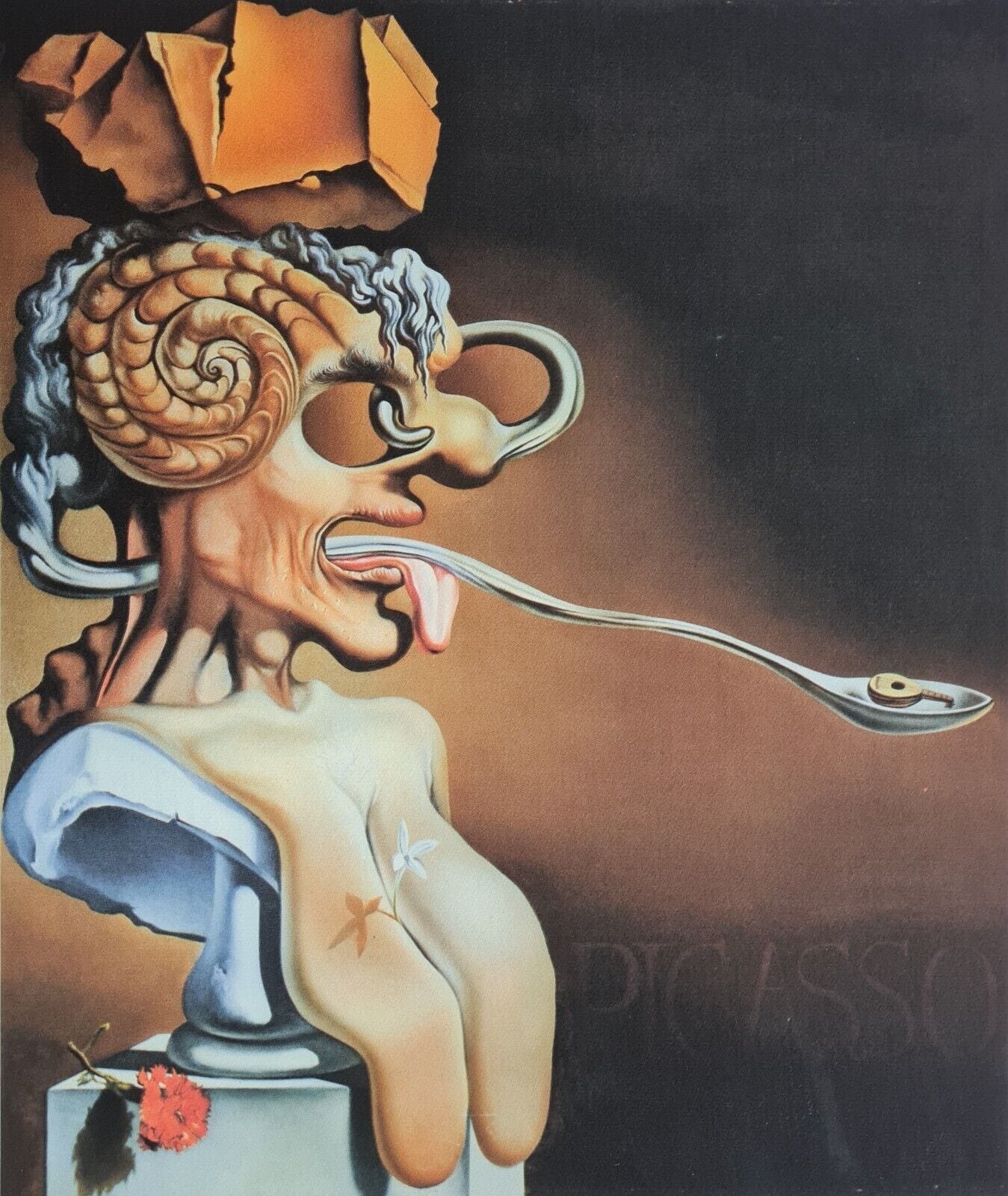
The Dalí portrait in the original note at the top is not decoration. I chose it because it adds to the words without taking from them, and because it is itself a compressed object: a face that is also a ram, a spoon, a sculpture, a smudged signature reading Picasso on a bust that is obviously not Picasso. Dalí painted Picasso and signed it Picasso -- a portrait that is also a forgery, by the painter who is not the subject, in the subject’s own name. The painting is a joke about authorship and resemblance and who-made-whom, which happens to be exactly what the byline is doing.
I did not plan that. I found the image, felt it was right, and only later realized why it was right. This happens a lot with compressed work. You compress on instinct and decompress on reflection.
How to recognize compression in the wild
Compression has tells. Once you know them, you start seeing them in places you didn’t expect -- text messages, song titles, the names of paintings, the way a friend signs off an email. Some of the tells:
Words doing two jobs at once. If you can read a phrase two different ways and both readings are operative, that’s not ambiguity -- that’s load-bearing. All fuses loose means both “about to fail” and “finally free,” and the writer means both.
Grammar that points at structure. Possessives, prepositions, articles. The Idiot’s frank Dr. is built around an apostrophe-s. Move that apostrophe and the whole thing collapses. When a small grammatical choice is doing a lot of lifting, slow down.
Things in the wrong category. Hearts that taste, blindness that smells, doctors that are frank. The category error is the signal: the writer is pointing at a place where the usual sorting doesn’t apply.
References that aren’t named. If a piece seems to be glancing at something it never says out loud -- a novel, a person, an earlier conversation -- it probably is. The unnamed thing is often the thing.
Image and text that argue with each other. Or rhyme with each other in a way that isn’t decoration. If the picture could be swapped out for any other picture, it’s an illustration. If it couldn’t, it’s a layer.
A method you can use
If you want to decompress someone else’s compressed prose, here is the procedure I use on my own. It works on aphorisms, song lyrics, poems, dense paragraphs, and -- occasionally -- text messages from friends who are not telling you everything they are telling you.
1. Read it once for the surface. What is the literal claim, if you take it at face value? Write that down in plain prose. This is layer one.
2. Read it again and look at the verbs. What is doing what to whom? Are any of the verbs in the wrong place -- are senses doing each other’s jobs, are abstract things behaving like physical things? List the swaps.
3. Read the small grammar. Apostrophes, plurals, articles. Whose is it. Which one is it. Is it a or the. Compressed work usually pivots on something tiny.
4. Identify what is not named. What is the piece pointing at without saying? A person, a book, a previous conversation, a private joke. You may not be able to fill in the blank, but you can usually locate the shape of it.1
5. Read the frame. Title, byline, image, where it was posted, what came right before it. Treat all of those as part of the text, because they are.
6. Ask what it is performing, not just what it is saying. Sometimes the form is the argument. A piece about how senses bleed together that uses senses doing each other’s jobs is performing its claim, not merely making it. That’s a different and stronger kind of writing, and worth noticing.
Why compress at all
A fair question. If I had to spend three thousand words unpacking four lines, would it have been kinder to write the three thousand words in the first place?
No. Because the three thousand words I am writing now exist because the four lines existed first. The compressed version is a seed. It contains everything in a form small enough to carry around, dense enough to keep generating, and shaped in a way that rewards re-reading. The decompressed version is what the seed produces when you give it soil and time.
The four lines already answered this question, by the way. They answered it in lines three and four. Blindness smells wrong is doing four things at once. Three words, quadruple bar. Bar one, literal: blindness has no nose, so the claim that it smells anything is a category mismatch on its face. An organ doing another organ’s job should register as wrong. Bar two, intuitive: being blind sounds bad on its own terms -- losing a sense feels like loss, not gain, no matter what the previous line just argued about subtraction sharpening the remainder. The counterintuitive sting is the point. Bar three, the rebuttal you already know: everyone has heard that blind people hear better, that deaf people see more, that losing a sense heightens the others. The folk knowledge corrects the gut. The line is wrong about being wrong. Bar four, the actual claim: the absence of sight has a smell. Not metaphorically -- structurally. When one sense is removed, something fills the vacated channel, and what fills it can be detected by the other senses in modes those senses don’t usually operate in. The line is a wrong-smelling thing claiming to smell, and you can feel the wrongness on first read, the same way you can feel a compressed unit refuse to fully declare itself. That feel is the point. But heart tastes the touch of rightness names what responds to it. The Spidey-sense. The pull to re-read. The signal underneath the surface wrongness that more is present than the wrongness suggests. The reader who has that response is the reader compression is written for. Everyone else is welcome to nod and scroll on.
---
Now look at what you have just done. I handed you a fully formed, manufactured object -- four lines and a byline, stitched together out of a text thread and a Dalí print and a novel and an unspoken thing between two people. I laid it on the table. I picked up the instruments. I cut. You watched.
That was an autopsy. You were the student. I was the doctor. The compressed unit was the body on the slab -- a creature small enough to fit on a phone screen and dense enough to hold a friendship, a novel, a painting, and a confession all at once.
So before you close the tab, scroll up. Look at the four lines again.
Listening helps us see.
Not seeing helps us listen.
Blindness smells wrong.
But heart tastes the touch of rightness.
– The Idiot’s frank Dr.
Read them now and you should feel something the first pass did not give you. Not a different meaning. The same one, with weight behind it. A friend’s charged silence. Two people learning to listen across a gap. A doctor who builds creatures and then meets one walking around outside his skull. A painting that is a portrait that is a forgery that is a joke. An organ that knows things the head refuses. All of it folded back down to twenty-three words, sitting at the top of a Substack post you almost scrolled past.
That is what compression does when it works. It does not hide the meaning. It loads it.
Which leaves one piece unaccounted for. I was the doctor. You were the student. The four lines were the creature. So who is the idiot.
The next compressed thing you crack on your own -- in a song lyric, a friend’s text, a film title, the name of a painting -- will not be a discovery I handed you. It will be one you made. Something fully formed, walking around outside the head of the person who tried to teach you. A real arrival, not a manufactured one.
When that happens, you will be at someone’s door.
Knock.

 | A guest post by
|
Beautiful ❤️
Eric, your use of synesthetic wire-crossing is a brilliant 'Bandwidth Hack,' I like how you force the reader’s Host-narrator to short-circuit, allowing the raw voltage of the Bitstream to land directly in the substrate. It’s not a poem; it’s a Trojan Horse.
I have a challenge for you: You’ve built a high-density 'Seed' in just 23 words, but the 'Decompression Method' you’ve provided us, is completely dependent on the Density of the reader. If the reader’s internal 'frank Dr.' is a hack rather than a scientist, they won't decompress your creation; they will accidentally assemble a Rorschach Monster that has your name but carries only their biases.
When you sign off as 'The Idiot’s frank Dr.,' are you handing over total control of the signal to the medium? How do you ensure that the DNA of the original 'Invention' survives the trip through the reader's distorted soil, or is the 'Real arrival' at the door simply the moment the author accepts that the creation was never actually theirs to begin with?